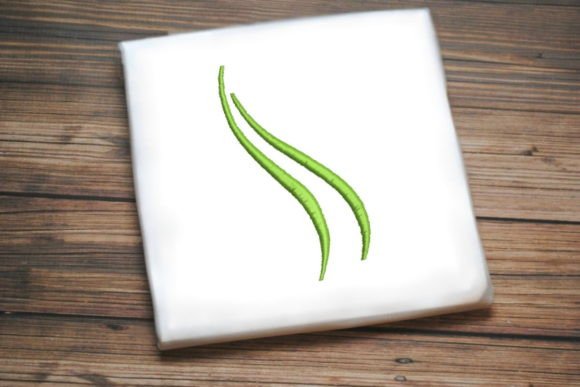
Green Thin Leaves Embroidery Review
A Delicate, Versatile Botanical for Real-World Stitching
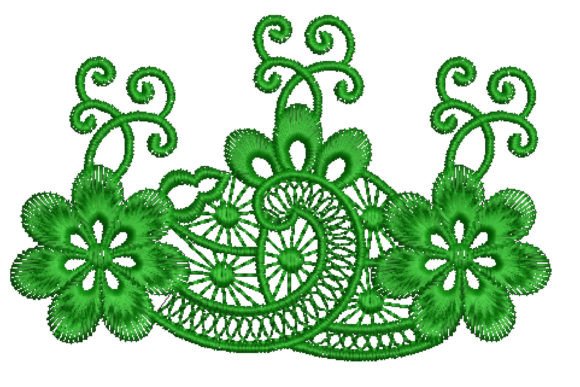
As someone who’s stitched thousands of designs across apparel, home goods, and boutique merchandise, I approached Green Thin Leaves with quiet curiosity—not hype. It’s listed under Single Flowers, but it’s not floral in the traditional sense. There’s no bloom, no center, no bold silhouette. Instead, it’s a fluid, asymmetrical arrangement of slender, tapering leaves—some curved, some upright, all rendered with subtle variation in width and angle. The mood is serene, organic, and quietly refined. It doesn’t shout; it breathes. That makes it unusually adaptable: equally at home on a linen baby blanket and a structured cotton tote bag.
What It Feels Like to Stitch — Not Just Look At
Green Thin Leaves is a machine embroidery design that prioritizes flow over fuss. Its stitching personality leans into graceful satin stitch outlines and soft fill stitch transitions—not dense, heavy coverage, but layered, airy definition. I tested it on medium-weight cotton twill (for aprons), French terry (for sweatshirts), and lightweight woven rayon (for pillow covers). On each, it behaved predictably: minimal puckering, clean edge definition, and no skipped stitches—even at moderate speeds (750–850 SPM).
The stitch density feels intentional—not sparse enough to look unfinished, not dense enough to stiffen delicate fabrics. That balance matters when you’re stitching for real customers: a baby blanket needs softness, a kitchen towel needs durability, and a custom apparel order needs consistency across sizes. I did notice one detail worth flagging: the thinnest leaf tips—just 1.2–1.5 mm wide—require steady tension and sharp needles (size 75/11 worked best). They held up cleanly on stable fabrics, but I’d avoid them on highly stretchy knits without additional cutaway stabilizer underneath.
Where Green Thin Leaves Truly Shines in Production
- Tote bags & aprons: The linear movement of the leaves follows natural drape lines—ideal for side seams or lower-front placement. No awkward distortion, even on curved edges.
- Sweatshirts & caps: Because it avoids tight corners and extreme angles, Green Thin Leaves hooped cleanly in a 4×4 hoop on both flat panels and curved cap fronts (with proper cap frame and tear-away + cutaway combo stabilizer).
- Baby items & nursery decor: Its gentle shape and lack of small isolated elements make it safer and more durable than intricate florals—no snag points, no fragile stems prone to fraying after repeated washing.
- Embroidered patches & handmade gifts: It scales beautifully from 2.5” to 4.25” without losing clarity. That flexibility lets you offer matching sets—e.g., a patch for a denim jacket and a scaled-down version for a onesie—without buying multiple files.
- Etsy listings & craft fair products: It photographs exceptionally well. The subtle dimension of satin-stitched veins catches light softly, adding depth to product images without needing complex lighting setups.
Design Assets That Support Your Brand—Not Complicate It
This isn’t just a digital embroidery file. It’s a quiet branding tool. Because Green Thin Leaves reads as understated rather than trendy, it supports long-term brand consistency—especially for makers focused on timeless, nature-inspired aesthetics. When used across your handmade product line (a linen tea towel, a ceramic mug sleeve, a set of embroidered napkins), it creates visual cohesion without repetition. Customers recognize the motif—not as a logo, but as a signature touch. That builds trust: they know what “your style” looks, feels, and wears like.
It also elevates perceived value. A plain cotton kitchen towel becomes a curated piece of home decor with this single element. A generic sweatshirt transforms into a personalized gift—especially when paired with monogramming or paired with neutral thread colors (olive, charcoal, oatmeal) that let the shape speak first.
Practical Notes Before You Stitch
- Always test on scrap fabric—especially if using textured weaves (like waffle-knit towels) or dark fabrics. The fine leaf tips can recede visually on black or navy unless you use high-contrast thread (e.g., mint on charcoal).
- Confirm hoop size compatibility. While it fits comfortably in a 4×4, check the actual dimensions on the Creative Fabrica product page—some versions may include alternate sizes or mirrored layouts.
- Review stabilizer strategy per substrate: light tear-away for stable wovens, cutaway + topping for knits or terrycloth, and water-soluble topping for dense textures like corduroy.
- Inspect small details post-stitch. Use a magnifier or phone macro lens to verify tip integrity and satin stitch smoothness—especially before packaging a personalized gift or shipping an Etsy order.
- Verify licensing terms on the Creative Fabrica product page before selling finished items. As a Commercial embroidery user, I always confirm whether the license permits unlimited end-product sales—this is critical for small business owners scaling handmade production.
Final Thoughts for Makers Who Stitch With Intent
Green Thin Leaves won’t replace your go-to script monogram or bold geometric border—but it fills a quiet, essential gap: the need for botanical elegance that works *reliably*, across *many* substrates and *real-world constraints*. It’s not flashy, and that’s its strength. In a market saturated with oversized florals and pixel-perfect digitizing, this design respects fabric, machine limits, and human attention spans.
For Creative Fabrica embroidery users building a library of versatile, production-ready assets, Green Thin Leaves earns its place—not as a novelty, but as infrastructure. It supports your workflow, enhances your finished product, and quietly reinforces your maker voice. Whether you're prepping for a holiday craft fair, fulfilling a wholesale order for boutique merchandise, or designing a printable mockup for your next Etsy listing, it’s the kind of embroidery file that does more with less. And in handmade business? That’s not just efficient—it’s sustainable.